
Why can two gauges measure the same leather differently?
A real case: leather declared at 0.80 mm was later measured at approximately 1.10 mm. The 0.30 mm discrepancy can affect the commercial value of the shipment. Before blaming the leather, check both the gauge and the method.
A 0.30 mm gap can affect the value of a shipment
A 37.5% difference relative to the declared thickness is significant. Conflicting readings alone do not establish which is correct: measure comparable areas under agreed conditions.
View genuine Calati gauges
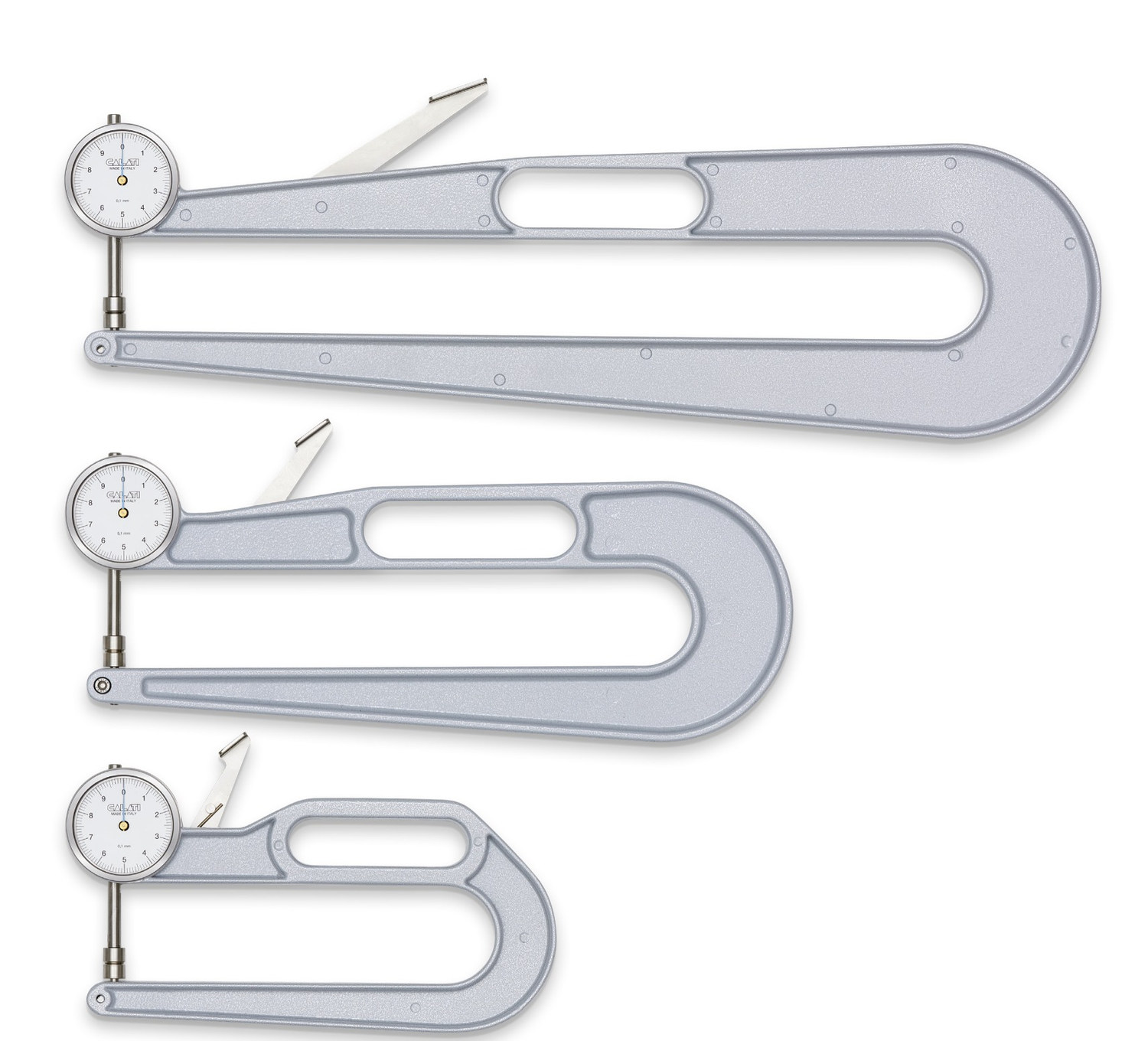
Below is an overview of the Calati 200, 300 and 450 mm fork gauges. Click the image to enlarge it.
Case photo: measurement comparison
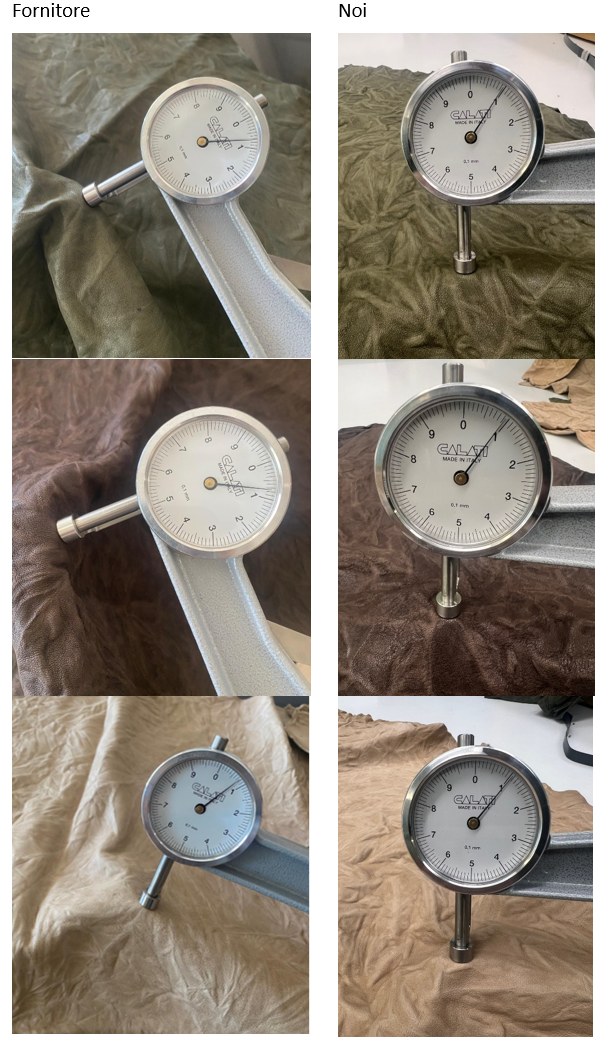
Danese checks the gauge: the supplier’s instrument was not a genuine Calati
After receiving the report, we compared photos of the supplier’s gauge with our original instruments. A review of the fork frame and casting details revealed structural differences. The supplier’s gauge did not match a Calati-manufactured instrument, even though its dial looked similar. The highlighted areas in the following photograph show what we found.
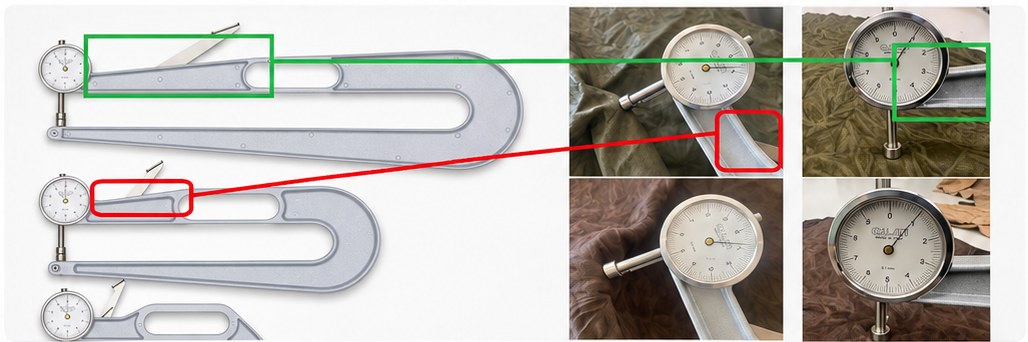
This establishes an origin discrepancy, not the exact cause of every tenth of a millimetre. A controlled test under identical conditions would be required to attribute the full 0.30 mm gap to the instrument alone.
Check zero
Lift the gauge perpendicular to the ground without resting it on a surface. Fully open the contacts with the lever and release them once or twice without a sample to check zero.
Correct measurement
Open the contacts fully, place the material between them, and allow the lever to descend naturally without guiding, pushing or forcing it. Read after the pointer stabilizes; avoid tilting the gauge.
Original or imitation?
A similar-looking dial or mark does not prove a gauge is an original Calati. In the reported case, Danese observed differences in the fork-frame casting compared with genuine instruments. Similar appearance does not establish equivalent measuring-force, geometry or tolerances.
Reliable measurements protect both parties
Before disputing a shipment, check the instrument, the method and the requirements of the applicable specification. Saving a few dollars on an unsuitable gauge can prove expensive.